A sports supplement distributor is a wholesale company that buys finished, branded sports nutrition products from many brands and resells them by the case or pallet to businesses: supplement stores, gyms, online sellers and importers. It doesn't make the products, it doesn't sell raw ingredients and it doesn't sell to consumers. The distributor you pick decides which brands you can put on the shelf, how fast you can restock and how much margin you keep, so it pays to compare a few before you open an account. Here is how to tell supplement distributors apart and what to ask each one.
What a sports supplement distributor does
A distributor sits between the brands and the businesses that resell them. A good wholesale supplements distributor:
- Carries many brands on one account, so you can order protein, pre-workout, creatine, aminos and bars from one supplier instead of opening an account with every brand.
- Sells by the case or pallet, at wholesale prices that leave room for your margin.
- Lets you mix brands in one order, so a small store can buy a few cases of each line instead of a pallet of one product.
- Makes reordering simple, by WhatsApp, phone, email or an order form, with an invoice for every order.
- Knows the category: which flavors move, which sizes regulars buy and which new lines customers are asking about.
A distributor that specializes in sports nutrition knows the brands gym customers ask for by name, which a general vitamin or grocery wholesaler may not carry.
Six kinds of supplier that show up when you search "supplement distributor"
Search for a supplement distributor and the first page mixes very different businesses. Each one solves a different problem.
1. Sports nutrition distributor
Sells finished, branded sports supplements from many brands to stores, gyms and online sellers, by the case or pallet. Best for: a business that wants the names customers already know, on one account.
2. Buying direct from a brand
Some brands run their own wholesale or trade programs. You get one brand per account, each with its own minimums, terms and shipping. Best for: a store built around one or two brands.
3. Bulk powder and ingredient supplier
Sells unbranded powders and raw ingredients by the kilo or the drum. Best for: brands and manufacturers that make their own products. It doesn't help a store that sells known brands.
4. Private-label manufacturer
Makes supplements under your own brand name, with formulation, labels and production minimums. Best for: launching your own brand. A distributor doesn't do this.
5. Practitioner platform
Supplies professional vitamin lines to clinics and health practitioners, often by dispensing to patients. Best for: clinics, not gyms or supplement stores.
6. Wholesale marketplace
An online platform where many small brands list wholesale offers. Best for: trying new or niche brands in small quantities. The big sports nutrition names are often not there.
You may also see companies that call their independent sellers "distributors". That is a sales role for one company's products, not a wholesale supplier.
10 questions to ask a sports supplement distributor
- Do you sell only to businesses? A wholesale-only distributor doesn't sell to consumers, so it isn't competing with the stores it supplies.
- Which brands and product lines do you supply? Ask for the product lines, not just a wall of logos. A distributor that can source other brands on request saves you a second account.
- Where does the product come from? Ask how the product is bought, whether it ships sealed in the original packaging, and whether there is a purchase record behind each shipment. The answer should be clear and the paperwork should exist.
- Do you sell by the case or by the pallet? Wholesale is usually by the full case. Ask whether you can mix brands, sizes and flavors in one order, and whether pallet orders are available as you grow.
- What is the minimum order, and how does pricing change with volume? Get both confirmed when your account is set up.
- Do you protect retail prices? A distributor that also sells to consumers can undercut the stores it supplies. Ask who else buys at the prices you are quoted.
- What will I see on the product? Every product should carry a batch or lot code and a printed expiry date. Ask how the distributor handles products with short dates.
- How will the order reach me? Ask where orders ship from, where they deliver and how damaged or short shipments are handled. If you are outside the US, ask whether the distributor can deliver to your freight forwarder or a US warehouse.
- What do you need to open an account? Most distributors ask for your business name, where you sell and a website or social profile. Some require a resale certificate or tax ID; others only ask for one.
- Who is my contact, and how do I reorder? A named sales rep who answers on WhatsApp or by phone makes reorders fast.
Red flags
- No company name, business address or phone number on the website.
- Prices far below every other source, with no clear answer on where the product comes from.
- Products that arrive without seals, lot codes or expiry dates, or with labels covered or removed.
- No invoice, or an invoice that doesn't match what arrived.
- Certification claims you can't find on the product. Certifications such as NSF Certified for Sport and Informed Sport belong to specific products and their makers, so check the label and the certifier's own list.
- A "wholesale" supplier that sells the same products to consumers at the price it charges you.
Which sports supplements a distributor should cover
These categories drive most reorders in supplement stores and gyms:
- Protein powder: whey, isolate, plant protein and mass gainers. See our wholesale protein powder page.
- Pre-workout: stim and stim-free formulas, in tubs and single servings.
- Creatine: powders, gummies and stick packs. See our creatine wholesale guide.
- Amino acids: BCAA and EAA.
- Fat burners and thermogenics.
- Protein bars and ready-to-drink shakes for the front desk and checkout.
- Vitamins and health: multivitamins, joint support and recovery.
For what sells fastest at a gym front desk, read what supplements sell in a gym. For the account steps, see how to buy supplements wholesale, and for a deeper look at vetting suppliers, read how to source supplements for your retail business.
How Legacy Supplements answers these questions
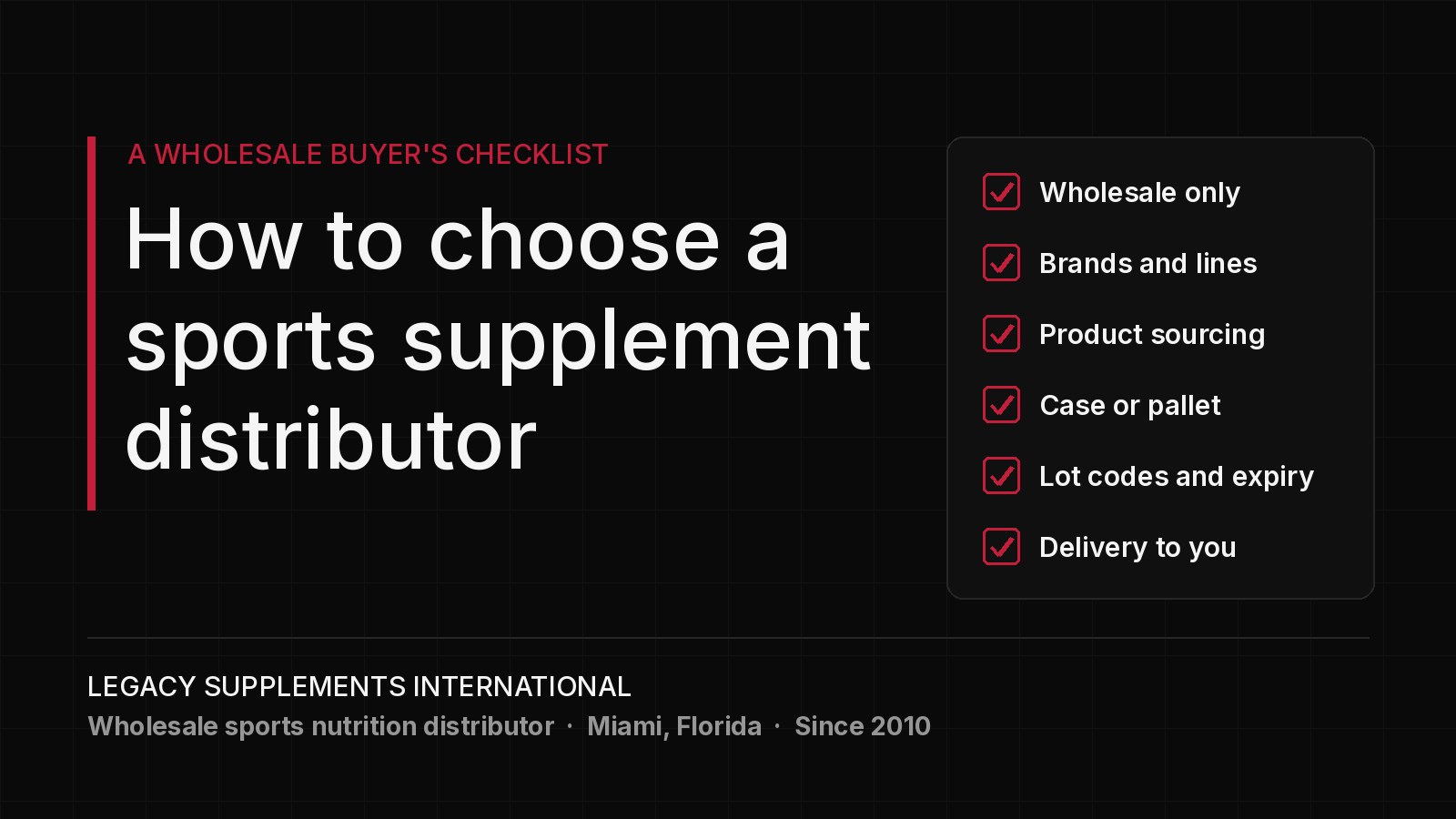
Legacy Supplements International is a wholesale supplement distributor in Miami, Florida, in business since 2010, focused on sports nutrition. Here is how we answer the checklist:
- Who we sell to: supplement stores, gyms, online sellers and importers. We are wholesale only and never sell to consumers.
- Brands: 5,000+ SKUs across 32 brands, including Nutrex, ALLMAX, BSN, Cellucor, Animal, Mutant, Rule 1 and Insane Labz, and we source other brands on request. See the full brand directory.
- Sourcing: We buy in the U.S. through established supply channels, and products ship sealed in their original packaging, with a purchase record for each shipment. We are an independent distributor, not affiliated with or endorsed by the brands we supply.
- Ordering: by the case or pallet, with brands mixed in one order. Your rep confirms minimums and pricing when your account is set up.
- Pricing: retailer-protected, because we sell only to businesses.
- Shipping: buyers in 30+ countries order through their own freight forwarder, and we ship across the US.
- Opening an account: send your business name, where you sell and your website or Instagram. A tax ID is optional.
- Reorders: by WhatsApp, phone, email or the order form.
Apply for a wholesale account, see how supplement distribution works, or find the program for your business under wholesale programs. Buyers in South Florida can also see our Miami supplement distributor page.
Frequently asked questions
What is a sports supplement distributor?
A sports supplement distributor is a wholesale company that buys finished, branded sports nutrition products, such as protein, pre-workout and creatine, from many brands and resells them by the case or pallet to supplement stores, gyms and online sellers. It doesn't manufacture products or sell to consumers.
Is a supplement distributor the same as a wholesaler?
The two words are often used for the same thing. A distributor usually buys from brands and supplies businesses across a region or market, while a wholesaler can be any business that sells in bulk to resellers. For a store or gym, what matters is that the supplier sells finished, branded products by the case, to businesses only.
Can a small store or gym buy from a sports supplement distributor?
Yes. Most distributors sell by the full case, and many let you mix brands in one order, so a small store doesn't need a pallet of one product. At Legacy Supplements, your rep confirms minimums and pricing when your account is set up.
How do I find a reliable wholesale supplements distributor in the US?
Look for a company that sells only to businesses, publishes its name, address and phone number, lists the brands and product lines it supplies, and explains where its products come from and how it ships. Legacy Supplements International is a wholesale-only sports nutrition distributor in Miami, Florida, in business since 2010.
Does Legacy Supplements ship outside the US?
No. Buyers in 30+ countries order from Legacy Supplements through their own freight forwarder: Legacy ships across the US from Miami and can deliver to a US warehouse or freight forwarder of your choice, after which you handle the shipping.